Celtic Origins
- An Abstracted Review -
The following article has been compiled from a variety of resources for the specific purpose of getting a grip on the development of Celtic in language and culture, in the context of a vigorously active field of studies. By abstracting, the opportunity for the reader to visit the original websites to further explore fully the respective works is encouraged, for the efforts and ownership of the original authors takes precedence at all times.
THE INDO-EUROPEAN FAMILY
Introducing the concept of the Indo-European family of languages, from The Indo-European Family - The Linguistic Evidence by Brian D. Joseph, The Ohio State University (2000):
"A stunning result of linguistic research in the 19th century was the recognition that some languages show correspondences of form that cannot be due to chance convergences, to borrowing among the languages involved, or to universal characteristics of human language,and that such correspondences therefore can only be the result of the languages in question having sprung from a common source language in the past.
What provides the basis for positing an Indo-European family and for relating the various languages is a set of striking correspondences of form among all these languages. These correspondences come at all levels of grammar, involving the sounds, the morphology, the lexicon, and the syntax. A large number of matching words across the various languages show parallels in meaning and/or grammatical function. For example, the words in the various languages for 'father' or 'mother':
Besides confirming the Indo-European family unity, these correspondences and matchings allow for the reconstruction of the sounds and forms of the parent language Proto-Indo-European, the reasoning being that the testimony of the offspring languages gives some insight into what the starting point must have been like. The overall evidence of these parallels among the Indo-European languages also allows for closer relationships to be discerned among the different branches. This is especially true when two or more branches share the same feature which is innovative with respect to the proto-language starting point. Italic and Celtic show special affinities, as do Greek and Armenian, and Balto-Slavic and Indo-Iranian, to name a few suggestive Indo-European internal groupings
The westernmost branch of Indo-European at the time of its first attestation is the group of Celtic languages. Although Celtic languages were spoken over much of the western European continent in ancient times, with traces attested in Gaulish and Celtiberian inscriptions from as early as the 3rd century BC, the main representatives of this branch are found in the British Isles. The most important Celtic language for Indo-European studies is Old Irish, attested in short inscriptions from the 4th and 5th centuries AD and in extensive literary documents from the 8th century; Welsh, too, is attested also from the 8th century
It is clear that Proto-Indo-European cannot simply have emerged ex nihilo 6,500 years ago; the origin of language is just too much farther back in the distant past for Proto-Indo-European to be viewed as being at the dawn of human language "
HOW DO WE KNOW WHAT WE KNOW ABOUT PROTO-INDO-EUROPEAN
From: Everything you ever wanted to know about Proto-Indo-European (and the comparative method), but were afraid to ask! (orig author Kathleen Hubbard, assistant professor of linguistics at the University of California, San Diego and published at utexas.edu)
"Cognates mean 'pair/set of words descended from a common ancestor', not just words that happen to look like each other (or) an instance of lots of borrowing of the same word by various languages. What we're talking about here are historically related words. When we know we've got cognates, we can talk about reconstruction.
"A whole huge raft of cognates (suggest) the same conclusion, /that Sanskrit had to be related to Greek and Latin, [initiating the] Neogrammarian move from philology (the comparison of texts) to what we now consider linguistics.
"PIE reconstructions are always preceded by a star * to show they're unattested [recorded], followed by a hyphen if they are roots that get suffixed, and with hedges if a vowel or something is uncertain -- consonants are much easier to reconstruct than vowels:
*ped- : foot
*bhrater- : brother
*bher- : carry
*gwei- : live
*sen- : old
*trei- : three
*dekm- : ten
"Proto-Indo-Iranian, and Proto-Germanic, and Proto-Balto-Slavic, and Proto-Celtic, [put together provides] a pretty good idea of what -- on the basis of very rigorous analysis -- must have been the forms of certain words/roots in Proto-Indo-European, before it split up. [Limit:] about 10,000 years.
"We know that the modern Romance languages (French, Italian, Spanish, Portuguese, Romansch, Rumanian, etc.) are descended from Latin. And we have lots of attested Latin to work with -- so we have clear, unambiguous examples of how some sound changes have worked. Likewise in other language families where ancient [e.g. religious] texts are preserved...so we have some real-life models on which to build."
INDO-EUROPEAN LANGUAGE DIVERGENCE
The following figure and its abridged legend is abstracted from Indo European Invasions of Europe - W.G.Davey (all rights reserved) (2008). The date of an undifferentiated proto-Indo-European langauge in the fifth millenium BC is provided in the companion study, Proto Indo European Dating.
These studies form part of a candidly written overall presentation that is well worth reading in full, and the abstracted information re-published here is used to illustrate the relationship of Celtic in the overall development of European langauges.
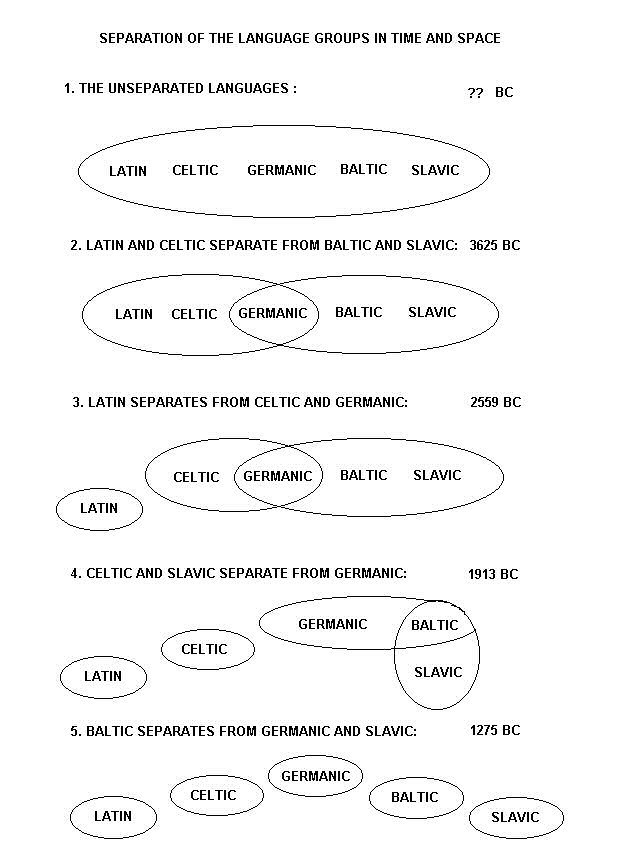 "Here we summarize another aspect of the overall study, namely how language changes can be used to investigate the manner in which the European language groups separated from each other and when these separations occurred. The results are consistent and show a striking pattern of change that is consistent with current archaeological and historical evidence.
Initially, up to some unknown date, we assume that the five groups have not separated at all. That is, all the languages are mutually intelligible.
The first movement towards separation, in 3625 BC, is one Latin and Celtic have diverged sufficiently that the speakers of these tongues can no longer communicate with Slavic and Baltic. We assume that these changes were the results of drifting of peoples within the area they occupy.
The second separation, about 1000 years later in 2559 BC, shows the complete separation of Latin from the other groups, perhaps the beginning of a migration south towards the Adriatic.
The third separation shows the movement of the Celts, presumably towards the South. The Celtic movement is consistent with what we know of the locations of the Celts in historical times.
The final, fourth, separation, in 1275 BC, shows the separation of Germanic and Baltic. The Germans, at least in part, probably moved south from the Baltic region since we know from history that the Germans appeared on the northern borders of the Roman Empire."
EMERGENCE OF CELTIC
Providing a backdrop to the emergence of Indo-European languages in Europe, and Celtic in temperate western Europe, the following is abstracted from: European Middle Ages - the Peoples: the beginnings, by Richard Hooker (1996):
"From about 6000 BC, the nature of European culture changed dramatically. It was about this time that agriculture was introduced into Europe by immigrants from the east and south. Throughout the fifth millenium, this new technology spread all over the face of Europe. What characterizes Europe from this point onwards was a fragmenting of European culture. Cultures became more localized, fueled by waves of immigrants both from outside Europe and moving within Europe.
The two most important of these immigrant groups are named after the artifacts they left behind: the Beaker people and the Battle-Axe people. The Beaker people, named after the Bell Beaker that is found in their sites, were, it seems, a war-like people, for their burial mounds include archery equipment and daggers. Most archaeologists believe that they originated somewhere in Spain. Their language was completely foreign to the languages now spoken in Europe.
It was the Battle-Axe people, however, that would form the nucleus of Europe to come. Named after the perforated battle-axes found in their sites, from the steppe lands of southern Russia, it is the Battle-Axe people that seem the most likely candidates for being the original Indo-Europeans.
Whatever the origin of the Indo-Europeans, the Battle-Axe people quickly spread over the face of Europe through migration, it is to be assumed, by force of arms over indigenous populations. By the latter part of the third millenium BC, the Battle-Axe people largely dominated the face of Europe. It was from this migrating population that the diversity of European cultures would spring
The first major culture to emerge after the influx of the Battle-Axe people was the Únetice, located in contemporary Czechoslovakia, who were greatly influenced by Mesopotamian culture with whom they carried on trade in copper and tin. This trade mediated through the Únetice extended as far north as Scandinavia; the culture of central Europe and the civilized East was extending. Europe became dominated in the second millenium BC by the Tumulus culture, so named after the large burial mounds, called tumuli, that they used for their dead. Largely because of trade with the east, the Tumulus culture developed strong and powerful chiefs. Finally, the Urnfield culture, or Proto-Celtic culture, comes on the scene at the end of the second millenium BC. Most archaeologists believe that most of the major elements of the European cultures had been fully formed in the Urnfield period, including the solidification of the warrior aristocracy and the overall social organization of the peoples.
In 700 BC, the peoples of Central Europe entered the Iron Age and the first major culture of the time was the Hallstatt culture (named after a site in Austria). This was the first genuine Celtic culture in Europe; they were replaced by another Celtic culture, the La Têne, in 500 BC. From these stocks would grow the most important, powerful, and culturally influential people of early European history, the Celts."
CLIMATE, FARMING, POPULATION GROWTH AS DRIVERS FOR LANGUAGE CHANGE
Providing a backdrop to climate change, Did Indo-European Languages Spread Before Farming? by Jonathan Adams and Marcel Otte, Current Anthropology, Vol. 40, No. 1 (Feb., 1999), pp. 73-77:
"The question of how Indo-European family of languages came to occupy a broad swathe of Europe and western Asia has long attracted discussion. Recent discussion of the prehistoric spreading of the Indo-European language group has generally concentrated on two alternative sets of hypotheses. On one hand there is the view that migrations of war-like cultures (e.g. the 'Kurgan' or 'Battle-Axe' Culture) had spread the languages out from a common point of origin through conquest of relatively passive farming populations. Another view is that the main event in the spread of the Western Branch of these languages was the initial spread of farming out of the Near East, providing a population 'wave' (due the increased carrying capacity of the farming lifeway) that swamped out the languages of hunter-gatherer groups, speaking non-Indo European languages, that had previously existed in the area.
A further hypothesis that past climate changes strongly affected linguistic patterns can also merge into the more traditional explanations; sudden climate change could have been the primary cause of migrations of IE-speaking neolithic farmers or horse-riding warriors. If one accepts the paleolinguistic view that such 'technology' words as 'wheel' and 'copper' were initially present at the point of divergence of Indo-European languages, and that they actually applied to technology items such as a fully-formed wheel or worked copper, then the 8,200 y.a. or the 5,900 y.a. climate events could have been important, respectively influencing migrations of farming groups or of horse-riding warriors."
From The Great DNA Hunt Archaeology Volume 49 Number 5, September/October 1996 by Tabitha M. Powledge and Mark Rose:
"In 1984 Albert Ammerman and geneticist Luigi Luca Cavalli-Sforza of Stanford University proposed that it was people practicing agriculture who spread into Europe, rather than the idea of agriculture. They argued that agricultural productivity led to population growth, and that, as the population grew, early farmers gradually moved into new land inhabited by fewer hunter-gatherers. Thus the practitioners of agriculture spread from Anatolia, beginning about 7000 B.C., to Greece and across all of Europe, ending in Britain and Scandinavia about 4000 B.C. DNA studies by Bryan Sykes using mtDNA analysis (mtDNA is found in the mitochondrion, the energy making organelle rather than the nucleus and passed via the ovum, so traces maternal inheritance), analyzing mtDNA from more than 800 modern Europeans, identified at least five main groups. Four of the five groups date to well before the last glacial peak, with ages ranging from 35,000 to 25,000 years ago. The fifth group is much younger in Europe (6,000 to 10,000 years ago) and has clear affinities to Near Eastern mtDNA. Sykes and his colleagues accept this as the genetic echo of the spread of agriculture, but note that it is fairly weak. They conclude that, far from being overwhelmed by incoming farmers, the indigenous hunter-gatherer population remained intact and learned how to farm."
From Examining the farming/language dispersal hypothesis, ed. by Peter Bellwood and Colin Renfrew (McDonald Institute Monographs). Cambridge: McDonald Institute for Archaeological Research (Distributed by Oxbow Books, Oxford, UK). 2002:
" There are enough language dispersals on record, both among foragers and among farmers, and enough dispersals of farming across areas maintaining their linguistic diversity to justify a single conclusion: joint dispersal of farming and language in prehistory may have occurred, but farming is at best one factor among several in the spread of a language. Among the numerous relevant factors in language spread, the chief one undoubtedly is always social.
Reconciliation of the early date of the spread of agriculture is plausible with the glottochronological age of the Indo-European family 6,000 BP (c.4,000 BC) supposing Indo-Europeans were implicated in a secondary spread of agriculture, and fits the lexical facts that indicate they were farmers before the supposed break-up of Proto-Indo-European, such as the terminologies from animal husbandry and arable farming and the possible language dispersals based on elite dominance."
CONCLUSIONS
The research on timing of the language divergences in Europe, and its causes, has much yet to do. Reasoned hypotheses that can be tested against archaeological findings will continue to be championed, challenged and mature, as is the nature of such investigations using the scientific method. For an appreciation of the events, however, the great phases of cultural development in Europe are able to be comprehended and appreciated. Just when distinct Celtic language and culture arose in Europe remains vague, but the timing at around the beginning of the second millennium BC for its divergence appears accepted. The archaeological Hallstatt period at 700BC, a thousand years later, is clearly Celtic. This time was when all the major players of ancient Europe came to develop into recognisable cultures of historical records. Much of the works abstracted above focus on the origins of the Indo-European languages in Europe; Getting a grasp on whether, or perhaps better: how, the Urnfield culture correlates to the time when Latin-Celtic-Germanic diversified into its distinct cultures and languages will be of great interest to follow.
Original work and design © Caer Australis 2011: From Coogee in Sydney's eastern beaches NSW Australia
The Gorsedd
Main Gorsedd menu The Fair Woman Mabon ap Modron Gwern in the Fire Celtic Origins Australian Standing Stones The River and the Well
Caer Australis
presents
'Owein,' said Arthur,
'call off thy ravens.'
'Lord,' said Owein,
'Play this game.'
- The Dream of Rhonabwy