


"Who can tell the Phases of the Moon?" - Song of Amergin
The Coligny Calendar - Correspondences to the Gregorian calendar
THE CELTIC AGE
samon duman rivros anagantios ogron cvtios || giamon semivisonna eqvos elemivios edrini cantlos
This presentation of the Celtic calendar defines the beginning of the traditional Celtic year based on a single and practical rule:
The first year of the Five Year Cycle begins with the first lunation following the heliacal rise of Saturn, at sunset of the first quarter phase of that moon.
Samon is the beginning of samrad (Samhradh, from *samo- for 'summer') and is the Gaulish version of the first month of summer:
Samon equates to Irish Cétemain, the month of Maytime and Beltaine: cetsoman .i. cetsámsin .i. cétlúd síne samraid.
'May(day), ie companionship of summer of antiquity'.
Giamon equates to Geimhreadh, from *gaimo- for 'winter': Gam quasi gamos isin greic, nouimber. .i. in mí gaim iar samuin
'The month of Gam, or 'Gamos' in the language of trade (Greek), is November'

 |
|
| Five Year Cycle example: 2002 to 2006 Refer Legend, below Beginning at the spring equinox at top, the cycle of years over a five year cycle is shown. The year commences in the Maytime (the Beltaine 'rebirth'), and there is a structural mirror-symmetry of month length centred on the winter cross-quarter (the Samhain 'veil') |
|
| The Five Year Cycle This example cycle commences the 30 year age (6 cycles per age) at Samon, on Gregorian date April 19, 2002 and finalises at last day of Cantlos, on Gregorian date March 24, 2007. Whereas each year commences relatively five days earlier sunwise, an intercalary in the middle of year 3 adjusts the calendar forward. The subsequent cycle commences five days advanced sunwise compared to the cycle shown with respect to Samon, with an intercalary month prior. In each cycle the 5 days solstice-wise advance adds up to one lunation over full age making intercalary year 1 cycle 1 unnecessary (so the unused intercalary displayed is Cantlos of previous year), but the month is used in cycles 2-6 of the 30 year age. The start date of the ages is stable, shown by comparison to the age commencing April 20, AD58. Legend Yellow months are Matus (30 days) Blue months are Anmatus (29 days); Piebald Eqvos year 1 due to attested 30 day period but is an anmatus month; Intercalary months: green; The first half of the month is lighter, the atenoux half darker; Refer text for further details. |
|
| Structure of a Celtic Year Maytime and the summer start Mí Gam and the winter second half. |
|
| Mids SAMON Mat meaning: 'Summer' compare Irish 'samrad' |
|
 |
|
| Ranges from May to June the time of Irish Beltaine |
|
| Mids DVMAN Anm meaning: 'Fumigation' . |
|
 |
|
| From June into July the solsticial days of summer |
|
| Mids RIVROS Mat meaning: 'Reap' . |
|
 |
|
| From July into August the harvest time |
|
| Mids ANAGAN Anm meaning: 'No-travel'? . |
|
 |
|
| August and into September the time of Irish Lughnasa |
|
| Mids OGRON Mat meaning: 'Cold' compare Welsh 'oer' and Irish 'fuar' |
|
 |
|
| September into October the autumn equinoctial period |
|
| Mids CVTIOS Mat meaning: 'Cover' compare Welsh 'cuddio' |
|
 |
|
| October and into November the end of the summer half of the year |
|
| Mids GIAMON Anm meaning: 'Winter' compare Irish 'gaimred' |
|
 |
|
| November the time of Irish Samhain |
|
| Mids SIMIVIS Mat meaning: 'Half-Spring'? . |
|
 |
|
| From December into January the solsticial days of winter |
|
| Mids EQVOS Anm meaning: 'Cattle' . |
|
 |
|
| January deepest winter |
|
| Mids ELEMBIV Anm meaning: 'Lambing' . |
|
 |
|
| From February into March the time of Irish Imbolg |
|
| Mids EDRINI Mat meaning: 'Light' compare Irish 'Aedh' |
|
 |
|
| From March into April the vernal equinoctial period |
|
| Mids CANTLOS Anm meaning: 'Song' compare Irish and Welsh 'canu' |
|
 |
|
| From April into May the days of springtime |
|
The Coligny calendar is a symbol of the cultural maturity of the Celtic Heroic Age, a timekeeping masterpiece relating lunar, solar and planetary cycles that is both practical for day to day use while describing a kind of model of the universe. It can even be argued that the Celtic calendar system was the envy of Rome, because Caesar called for calendar reform following his many years of exposure to Gallic culture during the conquest of Gaul; while prohibitions against the Druids decreed by Augustus from 27BC-AD14, Tiberius after AD14 and Claudius from AD41-54 (outlined below) show its suppression and provide a limiting date for the tablet's crafting. The reflections of Ausionius in the fourth century and the usurping of Beltaine in Ireland in the fifth provide a wider temporal and cultural context.

The bronze calendar inscription was discovered at Coligny in 1897 and is displayed at the musée gallo-romain de Lyon (see also: presentation by the museum). At each day, a small hole suitable for the placement of a peg or marker is provided, and so the tablet functions as a parapegma. The bronze tablet inscribes five consecutive years of twelve months that are 30 or 29 days in length, 354 days long, with two of the years containing an additional intercalary month of 30 days each bringing their duration to 384 days, the whole spanning a total of five days longer than five solar years. Within each year the pattern of month lengths displays two-fold complementarity, following the summer and winter cross-quarters. Omission of one intercalary month over six calendar cycles brings the calendar to an exact match with thirty solar years, described as an 'age' by the ancient sources.
References to Celtic timekeeping are found in the following ancient and medieval sources: Julius Caesar (Bellum Gallium, 6.18; 53BC), Diodorus Siculus (80-20BC) (Library of History 2,47), Plutarch (De Facie, Loeb p.185; about AD75), Pliny the Elder (Natural History, 17.95; written AD52-79), the Life of Patrick's description of the usurping of Beltaine by the Pascal fires in AD433, the Sanas Cormaic and other Early Irish Glossaries, the eleventh century Tochmarc Emer and, in providing their order, the sixteenth century Quatrains on Beltaine, &c. and Tóraigheacht an Ghiolla Dheacair.
The Celtic calendar marks off many time periods, known either from the inscription itself or the ancient sources from the period of its known use. The way that the astronomical cycles embedded in the calendar maintain accuracy over time is quite similar to the way Celtic knotwork resolves itself into a satisfying whole. There is a diurnal cycle with the daily period commencing at sunset; there are monthly cycles, divided into light and dark halves, commencing on the first-quarter phase of the moon, and every month is a lunation, which is in essence the beauty of this calendar following as it does the natural phenomenon of the waxing and waning moon; twelve months mark a year, which falls short of the solar year by about ten days, and to account for this there are cycles of five years, the period inscribed onto the bronze tablet as discovered at Coligny, which introduce at the very start and very middle of the five year cycle an extra month to align the calendar with the sun; and there is a thirty year age providing further alignment of the lunar and solar cycles and marked by the passage of Saturn, the outermost visible planet.
The broadest understanding of the arrangement of the calendar with respect to the seasons is able to be discerned by the names used for the first and middle months, including comparing them to the Irish and Welsh month or seasonal names. The first month, mids Samon means 'month of Summer', with mids corresponding to the Irish mís 'month' and samon meaning 'summer' and is cognate with Irish samrad etc., while the seventh month mids Giamon means 'month of Winter', with giamon meaning 'winter' and is cognate with the Irish gaimred, Welsh gaeaf etc. In addition to the Irish and Welsh seasonal cognates to the first and seventh Gaulish month names, the tenth century Sanas Cormaic refers to the month of May as cetsoman to the month of November as mí Gam, providing striking correlations to the Gaulish month names of nearly a millennium earlier.

The two-fold Celtic Year
The months mids Samon and mids Giamon head the two halves of the year on the calendar, and in Celtic language they resolve as the months of 'Summer' and 'Winter', consistent with the wider Indo-European and specifically Celtic language development and as shown by their Irish and Welsh cognates. Given the clarity of these correspondences, any explanation as to their position relative to the seasons will account for both months with equal satisfaction, and account for the names of the other months and events in their consequent positions within the seasons.
Interpretation of the Calendar and its relation to the seasons is an on-going effort, and reconstructions of the Celtic calendar have been produced that vary in the relative seasonal arrangement. There is no resolution at present, and no agreement as to what - if any - relationship exists for the Coligny calendar parapegma and the unknown pre-Roman Insular calendar systems. From the 1920s, the reconstruction of Mac Neill places Samon, the first month of the year, such that it includes the summer solstice. This reconstruction is available to view at University of Berkeley which includes the accompanying paper 'On the Notation and Chronography of the Calendar of Coligny, by Eóin Mac Neill © 1926 Royal Irish Academy', read before the Royal Irish Academy, April 28, 1924 (also available at JSTOR for those with access).
In the Encyclopedia of Religion and Ethics, part 5, by James Hastings (2003), on p.80 the month names mids Samon and mids Giamon are taken as meaning 'middle of summer' and 'middle of winter', respectively. This is explained by reference to the similarities of the Gaulish mids Samon to Irish mís míthemain, namely med-samain or medio-samoni, allocating its position therefore to June and the summer solstice. The rationale appears to based on the full title mids Samon being equivalent to the Irish month name míthemain without reference to the preceding mís, and is supported by an argument that the name of the fifth month mids Ogron 'month of cold' (from IE *ogro- 'cold') is sensible due it being consequently positioned in October at the turn towards winter (see also references to earlier supporting sources within).
Most interpretations of the two key Gaulish months place them at the start and/or end of summer and winter. Two relevant books illustrate this point. Stephen C McCloskey's "Astronomies and cultures in early medieval Europe" (2000) describes the Coligny calendar month of Samon being ascribed to the summer, but leaves open the possibilities that it includes the summer solstice or Samhain (p.58). John T Koch's Celtic culture - a historical encyclopedia (2006) states there is compelling evidence to attach either Samhain or Beltaine as the Celtic new year.
Using the mids Ogron 'cold month' consequential placement as a measure of the relative strengths of placing the first month mids Samon at the beginning or end of summer, we find that with a May mids Samon the placement of mids Ogron in September results, so around the autumnal equinox when the strength of summer's heat declines and the 'cold' period commences; and for the case of a November mids Samon a resultant March mids Ogron, around the vernal equinox when the first promise of summer is felt, and so producing no sensible explanation for 'cold'. This may be applied to any of the solsticial and equinoctial start dates with similar matches or non-matches to the concept of cold - spring equinox start: no match for cold, summer solstice and autumn equinox starts: matches, winter solstice start: no match.

The Celtic calendar clearly demonstrates the cultural link of language of northwestern Europe through the Celtic words and the concepts they define inscribed on the tablet - so that concepts of time held by the touta of Gaul may be usefully compared with those of the tuatha of Ireland. It is legitimate to ask whether Gaul, Britain and Ireland conducted timekeeping systems that functioned in like manner, such that Celtic culture extended in a consistent manner throughout the north-west.
A legitimate connection with Gaulish and Irish language and time-keeping customs is implied in arguments favouring the case of a November start to the year. Both mids Samon and Samhain contain in their names the stem *samo-, 'summer' and on that basis the names are claimed to be cognate, despite the Irish festival and month name being a compound word meaning summer-end. The month of November commences the Celtic winter, and given that the name of mids Giamon is based on the winter stem *giamo- and cognate with the terms for winter, namely Ir: Geamhreadh and Cym: Gaeaf, the name Samhain is readily understood as fortuitously resembling the first month of the Celtic calendar. The interpretation of Samon as being the equivalent of the Irish festival of Samhain is ultimately based on the arguments of Sir John Rhys in the Hibbert Lectures of 1886. This remains the most popular view, particularly among neo-pagan groups and being widely adopted as the 'Wiccan New Year' (see: Wikipedia) and a reconstruction in this arrangement is presented by Marc Carlson (Samon half and Giamon half).

An event marked on the seventeenth day of the Gaulish month mids Samon is the trinox samoni. The annotations across the five Samon months inscribed on the calendar differ, but they can be considered as variants of 'Trinvx Samoni sindiv' / 'three-night of Samon today', with an example shown at right. Like the Samon month itself, this event is widely and popularly reported to refer to the Irish festival of summer-end, both based on the proposition that 'Samon' and 'Samhain' are one and the same (see for example Alexei Kondratiev's 1997 article in the IMBAS Journal). 'Samon' and 'Samhain' do look similar, and do contain the stem *samo-, 'summer', but Samhain refers to summer's end: Sanas Cormaic in the tenth century describes November as in mí gaim iar samuin (Y 688), 'the winter month following samhain', and here we see that mí Gaim is in fact the Irish month equivalent to the Gaulish mids Giamon the seventh month, and demonstrates that the trinox samoni in the first month mids Samon occurs a full half year earlier than Samhain.
Moreover, the term trenae samhna has in turn held to be cognate with the trinox samoni and taken to mean 'the three nights of Samhain': such 'phonetic correspondences' were proposed by Tadhg MacCrossan in his book 'The Sacred Cauldron' (Llewellyn 1991, pgs. 207-208). The term trenae samhna is found in association with Samhain in its correct context in Serglige Con Culainn 'The Wasting Sickness of Cú Chulainn' (full text at CELT) recorded in the twelfth century Lebor na hUidre, the Book of the Dun Cow:
1] Óenach dogníthe la Ultu cecha blíadna .i. tri lá ría samfhuin
2] & tri laa íarma & lathe na samna feisne. Iss ed eret no bítis
3] Ulaid insin i m-Maig Murthemni, oc ferthain óenaig na samna
4] cecha blíadna. Ocus ní rabe isin bith ní dognethe in n-eret sin
5] léu acht cluchi & chéti & ánius & áibinnius & longad & tomailt,
6] conid de sin atát na trenae samna sechnón na h-Érend.
'Each year the Ulstermen held a fair; the three days before Samain, and three days after it and the day of Samain itself. That is the time that the Ulstermen used to be in Mag Muirthemni holding the fair, and nothing was done by them during that time but games and gatherings and pleasure and eating and feasting, so that it is from that come the thirds of Samain throughout Ireland.' (see Digital Medievalist - What is Samain or Samhain? for this translation, other exerpts and an associated discussion).
Comparison to the Insular month names applied to the Roman calendar in these lands shows striking resemblences:

In Sanas Cormaic, Cormac's Glossary, the month of May, now called Bealtaine, is called Céitemain and explained in B 210 thus: 'cetsoman .i. cetsámsin .i. cétlúd síne samraid', which is 'May(day), ie the first of summer, ie companionship of summer of antiquity'. Variant spellings are: cetsoman, cetsamun, cetsamain, cetshamuin, (Early Irish Glossaries database: 'cetsoman'). The entry for céitemain in eDIL - Electronic Dictionary of the Irish Language (use search word: céitemain) provides other references to May and Maytime of the same form. Thus in the Irish language the compound cet+soman is used to describe the Maytime, the first month of summer. The Beltaine celebration was usurped by Patrick in favour of Easter several centuries earlier (in AD433)..

The month of November, now called mí na Samhna or Samhain in Ireland, is referred to in the form mí Gam in Sanas Cormaic, and this corresponds to the Gaulish mids Giamon. In Y 673 it is specifically described as corresponding to November: 'Gam quasi gamos isin greic, nouimber', which is 'Gam, as though in Greek gamos, November' (Early Irish Glossaries database: 'gam'); at this time Greek was used as the language of trade (Stokes, G. 1892, 'The Knowledge of Greek in Ireland between AD500 - 900'). In Y 688, the month is described as following the summer-end festival: 'Gamain .i. in mí gaim iar samuin, unde dicitur gamnach .i. gam-sinech .i. arinni is mblicht i mmi gaim .i. i ngaimreth', which is 'Gamain (a year-old calf), that is, in the month of Gam (November), after Samuin (Hallowtide), and so to affirm, a milking-cow with a year-old calf because there is milk in mí Gam, that is in the winter' (Early Irish Glossaries database: 'gamain'); and in Y 674 and B 391 the month is found as 'mí gamh' and 'mí gaim' in a lament (Early Irish Glossaries database: 'gaimrith'). With regard to this lament, O'Donovan remarks 'mí Gam here certainly means the month of November, for S. Cumine Fota died on the 12th November, AD661: O'D.' (Cormac's Glossary (1868) translated and annotated by the late John O'Donovan; edited by Whitley Stokes).
This was the arrangement of the Irish year that Cú Chulaind explains to Loeg in Tochmarc Emer, an Irish hero-tale of the eleventh century: "For two divisions were formerly on the year, namely, summer from Beltaine the first of May, and winter from Samuin to Beltaine.", and of the year's division by the Fena as described in Tóraigheacht an Ghiolla Dheacair, a sixteenth century Irish manuscript, which reads, "For this was the manner in which the Fena used to spend their time. They divided the year into two parts. During the first half, namely, from Bealtaine to Samhain, they hunted each day with their dogs; and during the second half, namely from Samhain to Bealtaine, there was not a chief or a great lord or a keeper of a house of hospitality in the whole country that had not nine of the Fena quartered on him during the winter half of the year."
Nineteenth and twentieth century enquiries into the structure of the Irish and more generally Celtic year are examined elsewhere on this website (see: Fire feasts section article.) That examination demonstrates the concept of Samhain commencing the year originated at a relatively very late date, with the 1886 Hibbert Lectures presented by Sir John Rhys. The arguments presented for this view are shown to be in error, and based on misinterpretations and misrepresentations of source materials, such as Julius Caesar's comments on the daily period of the Gauls being measured from sunset. Weaknesses of the proposition that Samhain commences the year are also discussed by Ronald Hutton in his Stations of the Sun (1996) in the entries for Samhain, on the basis that customs of the ninteenth century are not able to be applied to the pre-Christian society of Ireland.
The Celtic calendar presented here is a development of the understanding of Samon as a 'summer' month, and proposes specifically that the beginning of the traditional Celtic year commenced in Maytime. The first year of each Five year cycle begins with the first full lunation following the heliacal rise of the Pleiades.
Two-fold Days, Months, Years, Cycles and a 30 year Age
The days, months and year
Caesar during his conquest of Gaul (53BC) reported the sunset beginning to the Celtic daily period: "they compute periods of time, not by the number of days, but of nights; they keep birthdays and the beginnings of months and years in such an order that the day follows the night" (Caesar, Bellum Gallium, 6.18). This sunset start to the daily period, remains a cultural hallmark, with the well-known feast days commencing at the eve of months on the Gregorian calendar used today.
Pliny the Elder provides the day of the moon on which the Celtic months began: this is the first quarter moon. He also assigns as the largest unit of Celtic time-keeping the 30 year age. He tells us that for the Druids of Gaul, "the fifth day of the moon [is] the day which is the beginning of their months and years, as also of their ages, which, with them, are but thirty years. This day they select because the moon, though not yet in the middle of her course, has already considerable power and influence; and they call Her by a name which signifies, in their language omnia sanantem the all-healing" (Pliny, Natural History, 17.95).

Commencing the daily period at sunset means that at the start of a month the moon is overhead, at its zenith, clearly split into light and dark halves. This is far superior to observing a new moon, or determining which day is the full moon, since these periods are extended and difficult to precisely note. The split quarter moon also reflects a running theme of two-foldness in the Celtic calendar, of which we will meet at each level up to the full calendar cycle of five years.
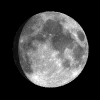
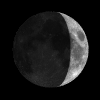
The Celtic concept of the month as a lunar period is verified on the Celtic calendar because the lengths of the months (29 or 30) and the number of months in each year (12 or 13) show that the months correspond to lunations (29.5 days); that the month starts at the first quarter moon is also supported, with each 'name' half followed by a second half headed by a label 'ATENOVX', which translates to 'returning dark'. Commencing at the first quarter, the evenings of the first 15 days of the month are brightly lit by the moon: it waxes to full moon and still rises early enough to light the late evening as it begins to wane. After the last quarter, during the atenoux half of the month, the moon rises after midnight and even as it passes new moon, it sets during twilight leaving the evening sky moonless, so this is the 'dark' half of the month.
The month being divided into its light 'name' and dark 'atenoux' halves is reflected in the structure of the year into two complementary halves, headed by epitome months, named 'summer' and 'winter'. The first six months, like the light half of each month, is the light and summery half of the year; the second six months, like the dark 'atenoux' half of each month, is the dark and wintery half of the year.
The names of the pairs of months in like positions of the two halves of the year also display a complementarity: Samon and Giamon (summer/winter), Ogron and Edrini (cold/light), Cutios and Cantlos (hidden/songs).
The structure of the year further displays a reflective complementary symmetry. The semi-alternating month lengths of matus 30 day (M) and anmatus 29 day (A) months that keep the calendar in time with the lunation period of 29.5 days are arranged in a pattern of two-fold complementarity. The point of reflection is at the winter solstice, specifically the Giamon (A) | Simivisonna (M) boundary, resulting in the pattern AMAMMA|MAAMAM. This pattern can also be considered to have a second point of reflection around the summer solsticeand associated trinox samoni, across the Samon (M) | Duman (A) boundary.
This structural symmetry seems to reflect or anticipate the concept of the Samhain feast being located where 'the boundary between the worlds' is thinnest. It also underscores an importance and significance of the winter cross-quarter as ancient as the opening of the year at the summer.
Over the course of the year there are some notable annotations inscribed on the calendar. Two series of annotations are the PRINNI days, that span a period of about a solar year over consecutive years. Full details are unavailable due to missing portions of the inscription, and therefore only attested dates are noted here. For some cases it is almost certain that all years mark the particular notation on the day, but for others this can be problematical.
Observations of these PRINNI series include the term itself, which appears to be related to the word 'tree' (W pren, I crann, as noted in 'The rise of the Celts', Hubert et al. (1934) p.234), and by extension/speculation to 'constellations', and there are hints here of some sort of 'tree calendar'. PRINNI LAG is associated with the Anmatus months, either directly or by virtue of further annotations on the Matus occurrences that refer to an Anmatus month (eg Sim 1 is annotated as a 'Giamon' day); the opposite is true for PRINNI LOVD in that it is likewise associated with Matus months. Both series are associated with the two-fold complementarity about the winter cross-quarter and its own complement after the trinox samoni.
PRINNI LAG commences at the winter cross-quarter, commencing at Simivis 1 (Y1,3,4) and proceeds step-wise over the following two months at one day advanced, namely Eqvos 2 (Y1,2,3,4,5), Elembivos 3 (Y2), then every other month at one day advanced, namely Cantlos 4 (Y1,2,3,4,5), Dvman 5 (Y1,2,3,4), Anagan 6 (Y1,3,4,5) and preceded two days earlier by the annotation OCIVM (Y3,4,5), Cvtios 7 (Y2 and not Y5)/Giamon 7 (Y5 and not Y3 where TIOCOBR[extio] occurs) and finally Simivis 8 (Y1, 3 and not Y4 where TIOCOBREXTIO (Simi 7)/SINDIV (Simi 9) occurs) - a total of 362 days from Simi 1 to Simi 8.
PRINNI LOVD also spans the same period, commencing after the trinox samoni and therefore six months off-set, at Dvman 1 (Y2,3,4), proceeding as follows: Rivros 2 (Y2,3,5), Ogron 3 (Y5), Cvtios 4 (Y2,5), disappearing in the winter half of the year apart from Cantlos 7 (Y3) and reappearing at Samon 7 (Y2,3 and not Y1 where EXINGI (Sam 3) occurs) and finally at Rivros 8 (Y2,3 and not Y1 where DEVORLUG (Riv 12) occurs, and in addition, BRIG (Riv 4, Y3,4) occurs).
TIOCOBREXTIO (cf tocht 'coming/going' and brecc 'speckled/mixed') days culminate at the spring equinox: in all years this day is marked on day 15 of Cantlos, the last day of the named light half of that month: it may denote the religious/official equinox.






The Seasons: Comparison to the Insular Celtic calendar system
Having established a meaningful understanding of the structure of the year, and established its beginning in the summer, we can examine the seasonal positions of the months and compare these in relation to the Julian calendar arrangements of the post-Roman Irish, Cymraeg and other 'Insular Celtic' calendars.
It is important to bear in mind when examining the Roman calendar systems developed in Britain and Ireland that the Julian system is fixed upon the solar year. In contrast, the Gaulish calendar is luni-solar and so flexible in its solar year correspondences, as can be seen by the depiction at the beginning of this presentation. For the sake of demonstration, year one of the fourth calendar cycle of the 30 year age is used for the Gaulish month positions, being the medial year and representing an average seasonal position, so to speak, for the months.
By understanding the Insular Celtic names of the months not replaced by Roman ones, a system of four seasonal trimesters is discovered - three months each for summer, fore-winter (autumn), winter and spring - in which prefixes for the beginning (*cet-), middle (*mean-) and end (*dered-) of each season designated the name of the Julian months. Both the Brythonic and Gaelic month names retain a portion of the system of first, middle and end-season names, exemplars being Ir: Cétamuin, Cym: Cyntefin - month of first of summer (May); Ir: Míthemain, Cym: Mehefin - month of middle summer (June) and Ir: Deireadh Fómhair - end of fore-winter (October) and Cym: Gorffennaf - finish of summer (July). Manx remains almost completely based on this system with the prefixes beginning (toshiaght), middle (mean) and end (jerry) of each season - for which an example of each is shown below.
| SAMON 30 days (*samo-, samrad) "Summer" |
Beltaine 12th C: mís Cétamuin 'month of first summer' |
May Ir: Cétamuin, Bealtaine Cym: Cyntefin, Mai |
GIAMON 29 days (*gaimo-, gaimred) "Winter" |
Samhain 10th C: mí Gam 'month of first winter' |
November Ir: Samhain (summerend) Cym: Tachwedd (slaughter) |
| DVMAN 29 days (fumigation) "." |
summer solsice month OI mís Míthemain 'month of middle summer' |
June Irish: Meitheamh Welsh: Mehefin |
SIMIVIS 30 days (.) "." |
winter solstice month Ir: Meán Geimhridh 'month of middle winter' |
December Ir: Nollaig (nöel; Lat. Natalicus) Cym: Rhagfyr (fore-shortened) |
| RIVROS 30 days (harvest + ur) "." |
late summer month Manx: Jerrey Souree 'month of end of summer' |
July Ir: Iúl (>Latin) Cym: Gorffennaf (finish of summer) |
EQVOS 29/30 days (cattle) "." |
late winter month Manx: Jerrey Geuree 'month of end of winter' |
January Ir: Eanáir (>Latin) Cym: Ionawr (>Latin) |
| ANAGAN 29 days (an + gant, ingantach) "Unwonted" |
Lughnasa *cet-Fogamar month of first fore-winter |
August Ir: Lúnasa Cym: Awst (>Latin) |
ELEMBIV 29 days (lambs) "." |
Imbolg Manx: Toshiaght Arree month of first spring |
February Ir: Feabhra (>Latin) Cym: Chwefror (>Latin) |
| OGRON 30 days (*ogro-, oer, fuar) "Cold" |
autumnal equinox Manx: Mean Fouyir month of middle fore-winter |
September Ir: Meán Fómhair Cym: Medi (harvest) |
EDRINI 30 days (aedh) "Light" |
vernal equinox TBDD: Medón Erraich month of middle spring |
March Ir: Márta (>Latin) Cym: Mawrth (>Latin) |
| CVTIOS 30 days (cuddio) "Cover" |
late autumn month Manx: Jerrey Fouyir end of fore-winter |
October Ir: Deireadh Fómhair Cym: Hydref (autumn) |
CANTLOS 29 days (cantla, canu) "Songs" |
late spring month *dered-Errech end of spring |
April Ir: Aibréan (>Latin) Cym: Ebrell (>Latin) |
The comparison above provides a comparison of the Gaulish, Irish and Cymraeg month names, and examples of the trimester naming system. (For a discussion on month names and their derivations, including also the Scots Gaelic, Cornish and Breton, see: Celtic culture: a historical encyclopedia, Volumes 1-5 (2006) by John T. Koch, p. 331, ). In the 16th century Togail Bruidne Da Derga (TBDD), the phrase 'ó medón earraich co medón foghmair' (from the month of middle spring [March] to middle fore-winter [September]' is found (line 599); also found in TBDD is the better documented mís mithemon (line 183).
What is immediately observable is that the Gaulish naming system is not like that of Ireland and Britain - this is in part why the placement of mids Samon at the beginning, middle or end of summer has been able to be suggested in various interpretations, as there is no explicit instruction of month placement in the Gaulish, as there is in the Insular calendars. As noted previously, the two semesters of summer and winter are clear on the Gaulish, and months at like positions within the semesters are named as complements or opposites. This makes it clear that the months Samon and Giamon head the semesters, and as already demonstrated, the equivalent Irish and Cymraeg names for first-summer and first-winter are their respective cognates.
There is a very good reason why the Gaulish luni-solar calendar does not name its months in a trimester system: it is not a solar based calendar. The variability in year commencement over a single five year calendar cycle, let alone the 30 year age, is such that Samon commencement dates vary by around forty-five days (compare year 3 cycle 1 to year 1 cycle 6, the earliest and latest samon start dates in the age - see below for an illustration and further discussion). Such variability is not a measure of inaccuracy, but rather the result of the calendar mathematics and the long term stability of solar and lunar cycles. Nevertheless, the set solar month positions for key periods such as the solstices, the *mean- months such as mís míthemain do not occur in the Gaulish system: the summer solstice may occur in the months of Duman or Riuros, depending on the period of the age.
Comparison of the Gaulish calendar - luni-solar and ancient - with the 'Insular' calendar system - solar and post-Roman - is able to be sensibly made on the understanding of this basic cultural difference. The Gaulish semesters commencing with Samon and Giamon do bear a stiking similarity to the Insular system, in that the month name meanings for like periods of the year do match: clear examples are the equinox months Ogron and Edrini: the meanings of 'cold' and 'light' for the September and March months do match the Meán Fómhair and Medón Erraich in representing the seasonal period. The Gaulish month Anagan, if it is indeed named with a word equivalent to the Irish compound An + Gant, ingantach ie 'Unwonted', can be seen as representing a period of significance the same as its manifestation as the 'Lugnassad' month in Irish, Scots Gaelic and Manx. The two Gaulish end-of semester months Cutios and Cantlos, whose names 'hidden' and 'songs' clearly are representative of the two Insular *dered months of the fore-winter and spring: just prior to winter the summer 'hides', and prior to summer the birds, and even the people, burst forth with song.
The months Cantlos and Cutios precede the beginnings of the two great seasons, Summer and Winter, and their names 'Songs' and 'Cover/Hide' form a complementary pair reflecting seasonal opposites. Cantlos, referring to Songs and preceding the start of the year in Samon 'Summer' reflects the happiness associated with the coming warmth, and also of the birdsong at this time of year; Cutios, referring to the Covering of the summer, its end and the imminent onset of wintertime may likewise be related to the world of birds as they leave for warmer climes. As an illustration of this, at right is presented a poem 'Enlaith betha...' (Birds of the world...) from The Martyrology of Tallaght, so dating to the eighth or ninth century. This poem is included in discussions of seasonal poetic references and the prevailing climate of the time in the work Chaucer and the cult of Saint Valentine, by Henry Ansgar Kelly (chapter 3). There is a quatrain within that relates to the swallow, appearing on the eighth of the calends of April, the vernal equinox, and leaving on eighth of the calends of October, the autumnal equinox. These dates represent the seasons after which the two months Cantlos and Cutios respectively appear on the calendar.
The five year cycle and the 30 year age

The five years shown on the bronze inscription describe a moon-and-sun cycle. At this level of structure, the mathematical genius of the Celtic culture comes to light. Since twelve months of the Celtic year last for twelve lunations, namely 354 days (6 x 30 day months + 6 x 29 day months; 12 x 29.5 day lunations), the total number of days in the year do not match the solar year of 365 days. The Celtic calendar solves the problem by using the Five Year cycle, and adding an extra month of 30 days at the beginning of the first year of each cycle and in the middle of the third year of each cycle.
In Year One, an extra month occurs before Samon, and in Year Three, an extra month occurs before Giamon. Therefore the Five Year cycle is divided into two 2.5-year halves, the two half cycles beginning with the extra months and each followed by 30 regular lunar months. In this way, the two-fold nature of a five year cycle may be appreciated. Therefore two-foldness is evident in each level of structure: days, months, years and five year cycles.
Year 1: An extra month prior to Samon(except first year of age), then 12 months (384 days)
Year 2: 12 months (354 days)
Year 3: 6 months, an extra month prior to Giammon, then 6 months (384 days)
Year 4: 12 months (354 days)
Year 5: 12 months (354 days)
This Five Year cycle is very efficient in keeping the solar and lunar alignments. The five calendar years total 1,830 days (5 x 354 days plus 2 x 30 days), compared to five solar years of 1826 days (5 x 365.25). As can be seen, over the course of every Five Year cycle, the calendar advances by five or six days compared to 5 solar years. The thirty year age comprises six Five year cycles, leading to an advance of about thirty days aver the age: The ancient Celtic astronomers and timekeepers could solve this drift by omitting the extra intercalary month prior to Samon at the start of the first cycle of the thirty year age, since the advance in days each cycle brings the days to their correct position by the end of the age.

Here we see the significance of the Thirty year age, as reported by Pliny the Elder. Plutarch around AD75 described a tradition known from Demetrius of Tarsus, who had then recently returned from Britain, that "at intervals of thirty years the star of Cronus, which we call 'Splendent' but they, our author said, call 'Night-watchman', enters the sign of the Bull, they, having spent a long time in preparation for the sacrifice and the expedition, choose by lot and send forth a sufficient number of envoys in a correspondingly sufficient number of ships ... while those who have served the god together for the stint of thirty years are allowed to sail off home" (Plutarch, De Facie, Loeb p.185). Diadorus also refers to a Hyperborean festival, that lasted "from the vernal equinox until the rising of the Pleiades" (Diodorus, Library of History 2,47), and the context is consistent with the year being complete at the heliacal rise of Taurus.
A lunation averages at 29.53 days, and over a Celtic age of six five-year cycles, there occur (6x62)-1 lunations, a total of 10,956 days. In thirty solar years, measured as 365.24 days each, there are a total of 10,957 days. That is a mere 1.6 days out of alignment. The calendar configuration itself marked out whole days, months, years and ages, according to a practical and most likely religious function. Certain months will not match the exact quarter moon, for there are periods of three 30 day months in a row. Therefore the specifics of the calendar become points of minute research. For example, the month Equos is named 'anmatus', associated with 29 day months yet inscribed with 30 days in year 1 (the only end of Equos attested). Based on a 30 day Equos in year 1, the number of days on the calendar calculates as follows: [(year 1: 355 + 5x 385) + (year 2: 6x 354) + (year 3: 6x 384) + (year 4: 6x 354) + (year 5: 6x 354)] = [2,280 + 2,124 + 2,304 + 2,124 + 2,124] = 10,956 days, one day less than 30 solar years.
Mids Ciallos: The intercalary months
The Celtic months are representations of actual lunations, and therefore the twelve months total a period some ten days short of the solar year. Thus the timing of the months in the second year is ten days or so earlier than in the first year; In the third year, Samon has fallen back some 20 days in the solar cycle compared to its relative position in the first year.
To 'catch up' with the sun, two 30 day intercalary months push forward the subsequent months by a lunation, bringing the months back in line with the Sun and the seasons. In the third year, such as in 2009, the intercalary month brings the beginning of Giamon the seventh regular month back to its seasonal position as it was in year one. The Celtic calendar inscription tells us this directly as inscribed in the heading and preamble to the second intercalary month, which reads:
![Intercalary month in Year III Headline and annotation CIALLOS B[V]IS SONNO CINGOS AMMAN.M.MXIII [...]LAT.CCCLXXXV [..B]ANTARAN M: musée gallo-romain de Lyon](images/intercal3.jpg "Intercalary month in Year III Headline and annotation CIALLOS B[V]IS SONNO CINGOS AMMAN.M.MXIII [...]LAT.CCCLXXXV [..B]ANTARAN M: musée gallo-romain de Lyon")
"CIALLOS B[V]IS SONNO CINGOS AMMAN.M.MXIII [...]LAT.CCCLXXXV [..B]ANTARAN M", and understandable as 'Sense pair for the Sun's progression - a period of 13 months made of 385 days in a year with an intercalary month'.
This has been generally understood since at least Mac Neill's 1924 paper on the Calendar, and the translation above is derived on the following basis:
1) CIALLOS B[V]IS 'sense, understanding', Irish, Old Irish ciall, Welsh pwyll; and 'pair' Irish dias, Latin bessis This is the header for this month;
2) SONNO CINGOS means 'sun progression' - SONNO and 'sun' being associated, while CINGOS is related to Old Irish cing, Gaulish cingeto- from *keng-o- 'tread, step, walk';
3) AMMAN.M.MXIII ... means 'time of months numbering 13", AMMAN.M from 'period of (time)' (Irish amm, dat. ammaimm 'a time'), months(M) 13 (XIII);
4) LAT.CCCLXXXV means '385 days', from 'days' *latia, Irish lathe 'day' and 385 (CCCLXXXV);
5) [...B]ANTARAN M means 'intercalary month', from the relationship of 'antar' to Irish 'etar', Latin 'inter', and thus 'antaran' to mean 'intercalary'.
In 2007 when the current five year cycle commenced, Samon corresponded with April 24 to May 23. In 2008, Samon was relatively earlier and corresponded to April 13 to May 12. In 2009, the third year, Samon has fallen further back, corresponding to April 2 to May 1. By including the intercalary month in year 3, the Celtic calendar restores Samon of 2010, the fourth year, to April 21 to May 20, bringing the year to a very similar position in the solar cycle as year one. The fifth year of the cycle, 2011, begins earlier again, April 10 to May 9. By the start of the next year, 2012 the first year of the next five year cycle, the other intercalary month is introduced prior to Samon, so that Samon corresponds to April 30 to May 30.
The intercalary months are introduced to allow the calendar to catch up with the solar cycle, but the cumulative effect is to produce a five year cycle some 5 or 6 days longer than five solar years. Every five year cycle moves slightly forward so that after the age has completed, the calendar does not require an intercalary month at its very start.
This presentation states that Samon is equivalent to the month of May, such that Samon and Cétemain are to be identified, both corresponding to the first month of the Celtic summer. However, as can be seen by the backward creep of the calendar compared to the solar cycle, in year 3 Samon is at its earliest and corresponds to April. This has very important implications to considerations of the usurping of Beltaine in favour of Easter by Patrick in AD433, because Easter and Samon do indeed coincide, showing that the assumed apocryphal story of Patrick and the usurping of Beltaine is in fact a plausible occurrence.

The above image displays mids Samon, the first regular month, and mids Ciallos, the intercalary month prior to Samon, for years 2002 to 2031, plotted with respect to the solar year using Gregorian dates. The date of the first day of each month is that of the first-quarter moon, verified using CyberSky (www.cybersky.com/). This start date to the month and the length of the Celtic age is in accordance with Pliny the Elder (Natural History, 17.95; written AD52-79). Samon (mids yellow/atenoux blue), the trinox samoni (dark blue days) and Ciallos intercalary month (mids light green/atenoux darker green) prior to Samon in cycles 2-6, in relation to the vernal equinox (green day line), summer solstice (yellow day line), Easter Sunday (pink days), Beltaine (as May 1, red day line), the solar 'Cross-Quarter', the midpoint between the equinox and summer solstice (orange day line) and the date of the Roman Lemuria festival (purple day line). This gives an overview of the luni-solar Celtic Calendar system: it is a lunar-precise calendar that accounts for the solar cycle using intercalation every two and a half years: a drift earlier towards the equinox occurs in successive years due to the length of twelve lunations amounting to a deficit of 10/11 days on the solar cycle, such that in year three an intercalation prior to the mid-year month mids Giamon results in Samon of year four to commence at a solar date close to year 1. After the duration of the age, sufficient overall solstice drift eliminates the requirement of intercalation prior to Samon of year 1. Demonstrating the lonevity of this Celtic age system, Days 1 of the previous and following ages (black bars at start year 1972 and at end year 2032) are extremely close to Day 1 of the example age given, 2002-2031. 2002 is the first year of the age shown, due to this being the year of Saturn appearing in Taurus as described by Plutarch (De Facie, Loeb p.185; about AD75). Notice also that the years 1 and 20 and years 20 and (by scrolling back around) year 9 of next age also align to the same solar position - this is the Metonic cycle, and the positioning of the year on the Metonic years exactly corresponds to Diadorus' description of the Hyperborean Metonic festival: Apollo celebrates from the vernal equinox to the rise of the Pleiades; Diodorus Siculus (80-20BC) (Library of History 2,47). The date of trinox samoni coincides with the cross-quarter day on the first year, subsequent Metonic cycle years and is within 10 days of the cross-quarter in over half of the age. This explains its positioning, but as it is not programmed to be co-incident with the solar cross-quarter, its position relative to the phases of the moon, at 25% illuminated waning crescent, is clearly also significant. The ancient sources cited are explored below. The days for Christian Easter are shown in order to demonstrate the principle that Patrick's usurping of Beltaine for Easter is plausible, and the date of the ancient Roman Lemuria is shown for comparison of this May fore-runner of All Martyr's (AD609) at the Pantheon and All Saints Day that was established at November in AD731-741 in Rome and AD831 throughout the wider Church.
Correspondences to the Julian and Gregorian calendar
A daily calendar of correspondences to the relevant months of Gregorian year 2011 is presented from the links to the right. Comparing the Celtic calendar to the Gregorian calendar assists in its understanding, as the seasonal progression through the Gregorian year is familiar to us due to its use today. We can superimpose our observation of the moon's phases on the calendar dates to meet the days in the ancient Gaulish manner. We also are able to follow the passage of the five year cycle, and discover the operation of the intercalary months.
To discover the start date of the beginning of the age and calendar cycles, the ancient sources are consulted with support of the Early Irish Glossaries and Irish and Welsh mythologies, from which the year 2002 is identified to commence the current 30 year age. This is the most recent year of Saturn's heliacal rise in Taurus, the year the age commences based on on the dialogue of Plutarch from around AD75 that described a tradition known from Demetrius of Tarsus, who had recently returned from Britain: "Now when at intervals of thirty years the star of Cronus...enters the sign of the Bull...those who have served the god together for thirty years return home.".
When Saturn most recently appeared beside the bright red star Aldebaran in the constellation of Taurus (shown in CyberSky illustration), its heliacal rise was in June. Anciently, the heliacal rise of Taurus was in May due to the precession of the equinoxes. However, the seasonal start to the year at the lunation of Maytime remains relevant as the start of the Celtic year. A more ancient age commenced in AD58 (shown below), and at that time the rise of Taurus was in Maytime; the age commencing AD58 is of interest as this period, AD58-88, was that in which Pliny the Elder and Plutarch recorded their histories including the snippets of information regarding Celtic timekeeping.
The example cycle AD2002-2006 is displayed at the top left of this presentation. It commences the current 30 year age (6 cycles per age) at Samon, on Gregorian date April 19, 2002. Showing all the months of the five year cycle allows observation of the Celtic calendar's mechanics. Whereas each year commences relatively ten days earlier sunwise, an intercalary in the middle of year 3 adjusts the calendar forward. The following (and current) cycle commences five days advanced sunwise compared to the cycle shown with respect to Samon, with an intercalary month prior. The solstice-ward progression of the start of the five year cycles is shown on the figure immediately above, where a complete age's Samon months are shown relative to each other, Beltaine (May 1st), the Solar Cross quarter date (6th May), Christian Easter and Roman Lemuria.

Sunset on the first quarter moon of April, 2002.
Saturn is located within the constellation of Taurus by the bright star Aldebaran,
and the other visible planets arrayed. Screenshot display using CyberSky4 (http://www.cybersky.com/).
see also: Harvard University Gazette, April 18 2002: Cromie, W.
'All planets will be visible for once-in-a-lifetime sight':
http://www.hno.harvard.edu/gazette/2002/04.18/01-planets.html
AD58: Mids SAMON Matus - the first month of a Celtic Age
G. Samon equiv. I. Samhradh corresp. Beltaine: transl. 'Summer'
cetsoman .i. cetsámsin .i. cétlúd síne samraid:
'May(day), ie companionship of summer of antiquity'
| I | II | III | IIII | V | VI | VII | VIII | VIIII | X | XI | XII | XIII | XIIII | XV |
| Apr20 IVOS |
Apr21 IVOS |
Apr22 IVOS |
Apr23 IVOS |
Apr24 | Apr25 | Apr26 | Apr27 FM |
Apr28 | Apr29 | Apr30 | May1 | May2 | May3 | May4 LQ |
 First Quarter
April 19, AD58 At zenith at sunset |
 Full Moon
April 27, AD58 Eastern horizon |
 Last Quarter
May 4, AD58 At nadir at sunset |
 New Moon
May 11, AD58 Western horizon |
| I | II | III | IIII | V | VI | VII | VIII | VIIII | X | XI | XII | XIII | XIIII | XV |
| May5 Solar CQ |
TRINOSAM SINDIV |
May7 | May8 | May9 | May10 | May11 NM |
May12 | Lemuria INIS |
May14 | May15 | May16 | May17 | May18 | May19 FQ |
| SAMHRADH - SAMON - SUMMER | GEIMHREADH - GIAMON - WINTER | ||||||||||
| SAM | DUM | RIUR | ANAG | OGR | CUT | GIAM | SIMI | EQV | ELEM | EDR | CANT |
Etymology
Gaulish Samon - summer
I. Céitemain - cétsoman:
cetsámsin .i. cétlúd síne samraid
'May(day), ie companionship of summer of antiquity'
I. Samhradh - Summer season
EI. Samrad, sam - summer
W. Haf - cognate of I. Sam-
Indo-E: *samo- summer
Sanskrit sámâ 'year'
"The Fena divided the year in two. During the first half, from Bealtine to Samhain, they hunted each day with their dogs"
- 16th Century Irish tale The Pursuit of Giolla Dacker and his Horse
Samon date correspondencesYear 1: April 24 - May 23, 2007
Year 2: April 13 - May 12, 2008
Year 3: April 2 - May 1, 2009
Year 4: April 21 - May 20, 2010
Year 5: April 11 - May 9, 2011
Sunset at Lugdunum, 19th April AD58 at the opening of Year 1 of the first Five year cycle that was contemporary with the ancient historians Pliny the Elder and Plutarch, who both describe a 30 year age, and between them specify the first-quarter moon start to months (Pliny) and Saturn's appearance in Taurus at the start of an age (Plutarch). Screenshot taken from CyberSky showing the moon at first quarter, visible planets and constellations, sunset local time.

Sunrise at Lugdunum, 6th May AD58 at the trinox samoni of Year 1 of the first Five year cycle that was contemporary with the ancient historians Pliny the Elder and Plutarch. Screenshot taken from CyberSky showing the moon, planets and constellations, sunrise local time. Cygnus the swan is at zenith, Cassiopeia ('Caer Arianrhod'), and Perseus the hero appear toward the sun, and the Pleiades at their heliacal rise, which Diadorus a century earlier described for the Hyperborean metonic cycle festival attended by Apollo. The moon two days into Atenoux, is a waning crescent of 25% illumination (a constant for the trinox samoni, as it always occurs at Samon Atenoux II and the months are set to the lunar phases).

Augustus, Tiberius and Claudius; the reflections of Ausonius.
For a review, see: Roman imperial themes, P.A.Brunt, Oxford: Oxford University Press, 1990, Note on the Druids pp. 483-487.
From: Pliny the Elder Natural History Book XXX, CHAP. 4. THE DRUIDS OF THE GALLIC PROVINCES translated by John Bostock, M.D., F.R.S. H.T. Riley, Esq., B.A. London. Taylor and Francis, Red Lion Court, Fleet Street. 1855.
"The Gallic provinces, too, were pervaded by the magic art, and that even down to a period within memory; for it was the Emperor Tiberius that put down their Druids, and all that tribe of wizards and physicians. But why make further mention of these prohibitions, with reference to an art which has now crossed the very Ocean even (ie Britain), and has penetrated to the void recesses of Nature? At the present day, struck with fascination, Britannia still cultivates this art, and that, with ceremonials so august, that she might almost seem to have been the first to communicate them to the people of Persia (or Persia to them). To such a degree are nations throughout the whole world, totally different as they are and quite unknown to one another, in accord upon this one point!
Such being the fact, then, we cannot too highly appreciate the obligation that is due to the Roman people, for having put an end to those monstrous rites, in accordance with which, to murder a man was to do an act of the greatest devoutness, and to eat his flesh (suggested as referencing the Sacrament of the Lord's Supper) was to secure the highest blessings of health."
From: Suetonius: The Lives of the Twelve Caesars, Claudius 25.5 translated by J.C. Rolfe.
(see also: translation at NoDictionaries.com)
"Druidarum religionem apud Gallos dirae immanitatis et tantum civibus sub Augusto interdictam penitus abolevit; contra sacra Eleusinia etiam transferre ex Attica Romam conatus est, templumque in Sicilia Veneris Erycinae vetustate conlapsum ut ex aerario pop. R. reficeretur, auctor fuit. cum regibus foedus in foro i[e]cit porca caesa ac uetere fetialium praefatione adhibita. sed et haec et cetera totumque adeo ex parte magna principatum non tam suo quam uxorum libertorumque arbitrio administravit, talis ubique plerumque, qualem esse eum aut expediret illis aut liberet."
transl.:He (Claudius) utterly abolished the cruel and inhuman religion of the Druids among the Gauls, which under Augustus had merely been prohibited to Roman citizens; on the other hand he even attempted to transfer the Eleusinian rites from Attica to Rome, and had the temple of Venus Erycina in Sicily, which had fallen to ruin through age, restored at the expense of the treasury of the Roman people. He struck his treaties with foreign princes in the Forum, sacrificing a pig and reciting the ancient formula of the fetial priests. But these and other acts, and in fact almost the whole conduct of his reign, were dictated not so much by his own judgment as that of his wives and freedmen, since he nearly always acted in accordance with their interests and desires.
From: Ausonius Book V, The Professors (Commemoratio Professorum Burdigalensium), translated by Hugh G. Evelyn White, M.A. London and New York. (The Loeb Clasical Library). 1919.
Ausonius was born around AD310, his father a native of Bazas and his mother of mixed Aeduan and Aquitanian descent. Following a thirty year teaching career, he became tutor to Gratian, and he witnessed Maximus in 383 usurp the Western Empire out of Britain, so his time links us to Macsen from the Welsh tales incorporated into Mabinogion editions. We are informed by White that "Ausonius was of Celtic blood ; and, extravagantly as Celtic claims are often overrated, it is possible that an element in his work, which is not due to his classical culture, should be ascribed to the genius of his race. This is a distinct appreciation for the beauties of Nature without reference to the comfort and gratification which they may afford to mankind. In the nature of the case such an element rarely finds its way through the crust which unimaginative surroundings and a thoroughly artificial education and career had imposed upon the nature of Ausonius ; but the subject of the Mosella afforded it some outlet.". From the Introduction, for his Celtic genius we are directed to the BOOK X. THE MOSELLE, composed in in AD371, 'closing his poem with an exaltation of the former above the streams of Gaul such as the Loire, the Aisne, and the Marne.' He also provides an extensive and intriguing treatise in BOOK XVI. A RIDDLE OF THE NUMBER THREE: including the triple goddess ('Triple in form is Hecate, three faces has virgin Diana; three the Graces, three the Fates, three tones hath the voice, three are the elements.'); In BOOK XI. THE ORDER OF FAMOUS CITIES, he celebrates his home city, 'Bordeaux is my native soil, where are skies temperate and mild, and well-watered land generously lavish ... Hail, fountain of source unknown, holy, gracious, unfailing, crystal-clear, azure, deep, murmurous, shady, and unsullied ! Hail, guardian deity of our city, of whom we may drink health-giving draughts, named by the Celts Divona, a fountain added to the roll divine !'
However, for the purposes of seeing the fate of the Druids, here are provided two entries from his poems commemorating the Professors of Bordeaux, directly referring to the esteem yet held for the Druidical families:
IV. ATTIUS PATERA [PATER] RHETOR "AETATE quamquam viceris dictos prius, Patera, fandi nobilis ; tu Baiocassi stirpe Druidarum satus, si fama non fallit fidem, tamen, quod aevo floruisti proximo iuvenisque te vidi senem, honore maestae non carebis neniae, doctor potentum rhetorum. tu Baiocassi stirpe Druidarum satus, si fama non fallit fidem, Beleni sacratum ducis e templo genus, et hide vobis nomina : tibi Paterae : sic ministros nuncupant Apollinares mystici..."
IV. ATTIUS PATERA, THE ELDER, THE RHETORICIAN: "Patera, renowned speaker, although in years you outpassed the men named earlier, yet, seeing that your prime was in the age next before my own, and that in my youth I saw you in your old age, you shall not lack the tribute of my sad dirge, teacher of mighty rhetoricians. If report does not lie, you were sprung from the stock of the Druids of Bayeux, and traced your hallowed line from the temple of Belenus ; and hence the names borne by your family : you are called Patera ; so the mystic votaries call the servants of Apollo..."
X. GRAMMATICIS LATINIS "nec reticebo senem nomine Phoebicium, qui Beleni aedituus nil opis inde tulit ; set tamen, ut placitum, stirpe satus Druidum gentis Aremoricae, Burdigalae cathedram nati opera obtinuit : permaneat series."
X. To THE LATIN GRAMMARIANS "Nor must I leave unmentioned the old man Phoebicius, who, though the keeper of Belenus' temple, got no profit thereby. Yet he, sprung, as rumour goes, from the stock of the Druids of Armorica (Brittany), obtained a chair at Bordeaux by his son's help : long may his line endure!"
Patrick and the Paschal fire at cohesamain.
"On the night of Easter eve, Patrick and his companions lit the Paschal fire, and on that self-same night Loigaire the King of Ireland held the high and solemn festival of Beltaine at Tara where the kings and nobles of the land were gathered. On that night of the year no fire should be lit until a fire had been kindled with solemn ritual in the royal house. Suddenly the company assembled at Tara saw a light shining across the plain from the hill of Slane.
'O King,' cried the druids, 'unless this fire be quenched this same night,
it will never be quenched;
And the kindler of this fire will overcome us all,
And seduce all the folk of this realm!'.
And Patrick quoted the Psalmist,
'Some in chariots, Some on horses;
But we in the name of the Lord!
Let God arise, and let his enemies be scattered!'
Then the queen came to Patrick and besought him,
'O mighty and just man!
Do not destroy the king -
Let him come and kneel and worship your God!'
From: The Life of St. Patrick and His Place in History, p. 104-106.

On Julian March 21st, a full moon rose. Easter computations using current tables and an equinox date of the 21st assign the following Sunday to be Easter Sunday, ie March 26th, but the timing of the full moon and the system that was used to calculate the Ecclesiastical full moon by Patrick's mission in Ireland at the time can lead to not that but the following full moon being designated the EFM. First, the EFM is not allowed to precede the equinox, and the combination of counting daily periods from sunset or if Patrick's mission was of the opinion of counting March 25th as the equinox, both could have precluded March 21st FM as being the EFM for his mission. That means that the following FM of the 20th April would have been counted as the EFM, with Easter Sunday following on the 23rd.
We do not know what system of calendar Ireland used at the time before the Julian calendar became established there. If the Irish then used an astronomically based system related to the Gaulish, the lunation of April/May will have been that of cét-soman, with the full moon heralding the summer occurring on April 20th: That may very well have been the setting for Laoghaire's Feast of Tara (the planets being suitably aligned - literally!) and the co-incidence of Patrick's probable EFM provided him his opportunity to light his usurping Paschal fires as described according to his Life.
The screenshot below attached shows May 1st's sunrise with a waning 25% crescent moon. This happens to co-incide with Samon 17th (Sam At II), so had the date been noted by those in Gaul of a few centuries earlier, it would have been a lovely spectacle to have on the trinox samoni. Maybe some diehards still did. Based on the heliacal rise of Saturn in Taurus as being year one of the Gaulish 30 year cycle, AD433 was a year 3 of cycle 5, ie year 23 of 30, and the first-quarter-start lunation period of mids Samon straddles May 1st and included May 13th, the Lemuria/feast for the Matryrs of Rome.
This reasoning again allows the story of Patrick's usurping fire recorded in his Life to be understood as a plausible event, not just an apocryphal tale symbolic of the establishment of Christianity.

From: On The Life Of Saint Patrick translated by Whitley Stokes (preserved at Internet Archive www.achive.org) and the English translation at Corpus of Electronic Texts. "ISandsin tanic cohesamain 7 cofergach m&gaid patraic oen donadraidib .i. lochru. 7 rosecnaig 1 don iris cm/aide. Tune sanctus patricius dixit...cotrdechaid z iarsin doirrsib foriattaib isintemraig. collar inrigthaigi. isandsin boi inrig ocfledugw^ corigraid eretm imi ar insollamainse .i. vair ba hi sin feis temra. " For that was a prohibition of Tara which the Gael had, and no one durst kindle a fire in Ireland on that day until it had been kindled first at Tara at the solemnity. And the wizards said 'unless that fire be quenched before this night, he whose fire it is shall have the kingdom of Ireland for ever. Then came one of the wizards, to wit, Lochru, fiercely and angrily against Patrick, and reviled the Christian faith. Tune sanctus Patricius dixit O my Lord, it is Thou that canst do all things : in Thy power they are : it is Thou that sentest us hither. Let this impious one, who is blaspheming Thy name, be destroyed in the presence of all. and there after he went into Tara, the doors being shut, to the middle of the palace. The king was then feasting with the kings of Ireland around him at this festival, for that was the Feast of Tara.

 The Southern Hemisphere
Australia and the Southern Lands experience the seasons off-set half a year to the Celtic homelands. Celebrating the Fire feasts with the progress of the southern seasons presents a dilemma, for at Beltaine on May eve, the southern seasons are turning to the winter; at Samhain on November eve, the southern seasons are at the time of rebirth at the start of summer.
Southern hemisphere
Samon and the Celtic new year
How does the identification of Samon with May respond to the claim that Samhain (ie the feast of November eve) begins the Irish year and that Samhain corresponds to Samon?
The question arises because as a result of the influence of the 1886 Hibbert Lectures presented by Sir John Rhys, Samhain has been widely held to commence the traditional Irish year. Neither O'Donovan or Bulfinch earlier in the nineteenth century were able to identify the start of the 'Pagan Irish Year' and Rhys was held to have discovered the identification of Samhain as the start. In the early twentieth century this was enthusiastically taken up by Squire and even Frazer wrote 'we may with some probability infer that they reckoned their year from Hallowe'en rather than Beltane.'
Consistent with this, at the discovery of the Coligny calendar in 1897, Samon was very quickly identified with Samhain. And because Samon without any doubt commences the Coligny calendar, this reinforced the idea that Samhain (ie the feast of November eve) was the start of the Irish year. Moreover, an event recorded in Samon months of the calendar, Trinox samoni was identified with the actual fire feast of Samhain, based on phonetic similarity to the Old Irish 'trenae samhna' and both taken to mean the 'three nights of Samhain'. There seemed no reason to question the relationship (despite neither term actually meaning 'three nights of Samhain' see: Digital Medievalist: Samain). The concepts became intertwined and by the later twentieth century, Piggot simply wrote of the November feast, 'Samain marked the end of one year and the beginning of the next.'
Averting the direct relationships between Samon and samhradh and Giamon with geamhreadh, the concept of ellipsus has been introduced to explain why neither Samon nor Giamon translate to 'end of summer' (Samhain is a compound of sam + fuin) or 'end of winter' (which should be by this reasoning a compound of gam + fuin).
But the concept of Samhain (ie the feast of November eve) marking the new year was in the first place an invention. Sir John Rhys said of Cormac's Glossary, 'I should propose to mend the original' and made Fogamur out to be not just the last month of the autumn, but the last month of the year, 'so that the first day of the first month of winter was also the first day of the year.' To give his idea an historical basis he drew upon Caesar's description of the Gauls, claiming that Caesar said 'The Celts reckoned Dis the father of all, and regarded darkness and death as taking precedence over light and life ; so in their computation of time they began with night and winter, and not with daylight and summer' and this, he wrote, 'is probably the key to reckoning years as winters'.
Rhys in fact mis-quoted Caesar by adding words to his observation. What Caesar actually said translates to 'The Gauls claim all to be descended from Father Dis, declaring that this is the tradition preserved by the Druids. For this reason they measure periods of time not by days but by nights; and in celebrating birthdays, the first of the month, and new year's day, they go on the principle that the day begins at night'. Some translations use the term 'seasons' instead of 'periods', both referring to 'passage of time', and in no way does Caesar mention the seasons or winter or summer.
Even if the lectures given by Sir John Rhys are discounted, and the phonetic similarities between 'Samon' with 'Samhain' and perhaps of the 'trinox samoni' with 'trenae samhna' be relied on, the clear etymological relationship of Samon to cetsoman and Samhradh in conjunction with that of Giamon to mí Gam and Geamhreadh, must be accounted for.
We have the Irish literature of Tochmarch Emer from the eleventh century, and Giolla Dacker and his Horse from the sixteenth century, in which the first half of the year is positively identified as commencing with Beltaine.
A summer beginning for the year is consistent with the significant events associated with Beltaine. This date commemorated the landing of the first invaders of Ireland, the sons of Partholan, on which day was lit the first fire, that of Uisnech. The arrival of the Tuatha de Danaan, beginning life in a new land was at Beltaine. The young heroes of Celtic myth such as Pryderi were born at Beltaine, and Finn gained druidic inspiration after eating of the Salmon of Knowledge at Beltaine.
None of this diminishes Samhain, a time of profound prophesy. In the fifth century, King Dathi commemorated Beltaine 'with a scale of splendour never before equalled' as 'a conference with all the great chiefs and leaders of the nation'. This was in response to powerful prophetic declarations by Doghra, chief Druid, at the previous Samhain where Dathi was announced to be the future king of Ireland and Alba. The Beltaine conference was the launch of his summer campaigns that took him as far as the Alps.
What is notable about Beltaine is that it was the first Celtic feast to be usurped by Christianity. St Patrick described the Beltaine feast as 'an idolatrous ceremony, with manifold incantations and magical contrivances when the Druids, singers, prophets had been summoned to Laoghaire at Tara'. Dathi's conference and Patricks usurping of Beltaine occurred within decades of each other, a testament to the profound changes brought on by Christianity.
The ancient sources: The Pleiades cycle and the Celtic calendar
Presented here are reports from the ancient sources relating to the Pleiades and the Celtic calendar system. The distinctive star cluster within the constellation of Taurus has long served humankind as the signal for the turn of the seasons: Their ancient rise in May signalled the coming warmth of summer; their setting the cold of winter. Of far greater utility than the solsticial extremes of the sun in deep winter or high summer, the Pleiades provided the signals for the seasonal transitions and the timing of agricultural practices vital to the well-being of communities. The rising of the Pleiades occurs when their celestial appearance over the eastern horizon co-incides with the rising of the sun. In the first millennium BC, this occurred in May, though today they rise in June.

By the time of the rise of the Celtic culture as a distinct member of the Indo-European family, typically dated to the eighth century BC with the Hallstatt archaeological period, the Pleiades had been long recognised for their significance. The cluster appears in mythologies from around the world (for a review see Pleiade.org's 'The Pleiades in mythology' http://www.pleiade.org/pleiades_02.html). From the Bronze age of Europe has been discovered a bronze device, the 'Nebra Star Disc', dated to 1600BC, featuring the Sun, Moon and Pleiades (see: Landesmuseum für Vorgeschichte website). The Greek poet Hesiod wrote of their astronomical signposting in the eighth century BC as the iron age reached Europe (Hesiod, Works and Days, 380). The Celts of Britain and Gaul marked a thirty year celestial cycle completed when Saturn returned to the sign of Taurus (Plutarch, De Facie, Loeb p.185) marking an 'age' in their calendar system, as recorded by Pliny the Elder in the first century AD (Natural History, 17.95). The rise of the Pleiades also marked the completion of a lunar festival in Britain, as the moon completed a nineteen year Metonic cycle (Diodorus, Library of History 2,47).
The Nebra Star Disc

The Pleiades were recorded in Bronze age Europe as a cluster of stars on the 'Nebra Star Disk', dating to around 1600BC and produced from metals found in Europe (Secrets of the Star Disc, 2004). The disc combines images of the Sun and Moon, an arc delineating the angle on the horizon produced between solsticial extremes, and a star-field in which appear a distinctive cluster of seven stars, the Pleiades. The disc is presently exhibited at the Landesmuseum für Vorgeschichte in Halle, Germany, described as "an in-depth view of the astronomical knowledge" of pre-historic Europeans (see: Landesmuseum website http://www.lda-lsa.de/himmelsscheibe_von_nebra/ and 'Secrets of the Star Disc', transcript of BBC2 presentation, 2004. http://www.bbc.co.uk/science/horizon/2004/stardisctrans.shtml).
Hesiod's 'Works and Days'

The poet Hesiod wrote in the eighth century BC an epic poem describing the passage of the year and the tasks to perform during its course. Within its lines, the Pleiades are mentioned as markers of the seasons: "[380] More hands mean more work and more increase. If your heart within you desires wealth, do these things and work with work upon work. When the Pleiades, daughters of Atlas, are rising, [in May] begin your harvest, and your ploughing when they are going to set [in November]. [385] Forty nights and days they are hidden and appear again as the year moves round, when first you sharpen your sickle. This is the law of the plains, and of those who live near the sea, [390] and who inhabit rich country, the glens and hollows far from the tossing sea: strip to sow and strip to plough and strip to reap, if you wish to get in all Demeter's fruits in due season, and that each kind may grow in its season" (Hesiod, Works and Days, 380).
Celebration of the Hyperboreans

Diodorus Siculus, who lived from 80-20BC, was a Greek historian of Agyrium in Sicily who wrote forty books of world history, called Library of History. He relates, "facing the land of the Celts in the parts of the Ocean, there is an island, which is not smaller than Sicily, situated in the northern region and inhabited by the Hyperboreans, who are called by that name because their home is beyond the point whence the north wind [Boreas] blows" (Diodorus, Library of History 2,47).
The Hyperborean priests are reported by Diodorus to a hold a luni-solar festival complete at the rising of the Pleiades every nineteen year 'Metonic' cycle. Meton, the fifth century BC Greek astronomer, discovered that every 235 lunations, equal to nineteen solar years, the full moon occurs on the same calendar date.
He relates, "The account is also given that the god [Apollo] visits the island every nineteen years, the period in which the return of the stars to the same place in the heavens is accomplished; and for this reason...is called by the Greeks the 'year of Meton'. At the time of this appearance of the god he both plays on the cithara and danced continuously the night through from the vernal equinox until the rising of the Pleiades, expressing in this manner his delight in his successes" (Diodorus, Library of History 2,47).
The Thirty Years of Cronus
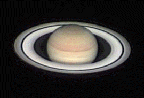
Plutarch's dialogue 'The Face in the Moon' was inspired by a total solar eclipse observed in the Mediterranean, probably that of AD75. Here, an account is given of Cronus, father of Zeus, entrapped on an island in the Ocean westward of Britain, "Cronus himself sleeps confined in a deep cave of rock that shines like gold - the sleep that Zeus has contrived like a bond for him" (Plutarch, De Facie, Loeb p.187).
The myth of Cronus may have been suggested to Plutarch by Demetrius of Tarsus, who is said in the dialogue to have recently returned from Britain, and he may be relating a Celtic legend that was suitably Hellenized by Plutarch for his audience (De Facie, Loeb Introduction). The information was obtained after the Claudian invasion of Britain in AD43; not long before the composition of this dialogue, the Druidic groves on the island of Môn had (in AD61) been attacked.
In Plutarch's account are reflections of a comment made by Caesar in 54BC, who wrote, "The interior portion of Britain is inhabited by those of whom they say that it is handed down by tradition that they were born in the island itself: the maritime portion by those who had passed over from the country of the Belgae for the purpose of plunder and making war; almost all of whom are called by the names of those states from which being sprung they went thither" (Caesar, Bellum Gallium, 6.18). Plutarch's relates, "These people consider and call themselves continentals and the inhabitants of this land islanders because the sea flows around it on all sides" (Plutarch, De Facie, Loeb p.183).
Similarities to the Irish Book of Invasions are seen in Plutarch's account, "they believe that with the peoples of Cronus there mingled at a later time those who arrived in the train of Heracles [who] rekindled again to a strong, high flame the Hellenic spark there which was already being quenched and overcome by the tongue, the laws, and the manners of the barbarians. Therefore Heracles has the highest honours and Cronos the second" (Plutarch, De Facie, Loeb p.185).
With respect to Celtic time-keeping, Plutarch relates, "Now when at intervals of thirty years the star of Cronus, which we call 'Splendent' but they, our author said, call 'Night-watchman', enters the sign of the Bull, they, having spent a long time in preparation for the sacrifice and the expedition, choose by lot and send forth a sufficient number of envoys in a correspondingly sufficient number of ships ... while those who have served the god together for the stint of thirty years are allowed to sail off home" (Plutarch, De Facie, Loeb p.185).
Pliny the Elder
The thirty year circuit of Saturn is presented in Pliny the Elder's discourse of the planets and their attributes: "It is certain that the star called Saturn is the highest, and therefore appears the smallest, that he passes through the largest circuit, and that he is ac trigesimo anno ad brevissima sedis suae principia regredi at least thirty years in completing it" (Pliny, Natural History, 2.6). This section 'Of The Nature Of The Stars; Of The Motion Of The Planets', published in AD77 is an invaluable resource as an insight into ancient perceptions of the universe.
Thirty years is the period Pliny assigns as the largest unit of Celtic time-keeping. He tells us that for the Druids of Gaul, "the fifth day of the moon [is] the day which is the beginning of their months and years, as also of their ages, which, with them, are but thirty years. This day they select because the moon, though not yet in the middle of her course, has already considerable power and influence; and they call Her by a name which signifies, in their language omnia sanantem the all-healing" (Pliny, Natural History, 17.95).

Pliny, who composed his encyclopaedic work in the period following AD52 until his death in AD79 whilst studying the eruption of Mt Vesuvius, positively identifies the thirty year period as part of the Celtic calendrical system. That the Celts used the first-quarter moon as the first day of their months explains why their period of the day extends from successive sunsets: on the first day of the Celtic month the moon is directly overhead split into dual sunlit and dark halves, a precise astronomical observation.
Caesar a century earlier (53BC) reported the sunset beginning to the Celtic daily period: "they compute the divisions of every season, not by the number of days, but of nights; they keep birthdays and the beginnings of months and years in such an order that the day follows the night" (Caesar, Bellum Gallium, 6.18).
It is of historical interest to see that after the conquest of Gaul, Julius Caesar gathered "the best scholars and mathematicians of the day" (Plutarch, Life of Caesar, 59) to standardise and correct the Roman calendar, for "there had been great confusion among the Romans with regard to the relation of the lunar to the solar year, with the result that the festivals and days of sacrifice gradually got out of place [in the Roman system; and] the priests ... would suddenly insert in the calendar the intercalary month known as Mercedonius" (Plutarch, Life of Caesar, 59). After nearly a decade in the Celtic lands, Caesar would have become familiar with the Celtic system, and perhaps he was inspired to repair the Roman system. He set new year's day at January 1, around mid-winter, and as the Celtic lands came under Roman rule so too did they need to adapt their own festivals to the Roman calendar.
The Celtic Calendar System and the Pleiades
The ancient sources provide us with insight to the importance of the May rising of the Pleaides. From their Bronze age forebears through to the times of Roman conquest, the Celts across the sweep of northwest Europe and the islands of the Ocean are shown by the ancient historians to have keenly marked the Pleiades in their religious astronomical observations and festivals. The rise of the Pleiades and the constellation of Taurus in May marked the thirty year age, as the planet Saturn completed its circuit of the heavens. The most recent conjunction of Saturn in Taurus was in AD2002, when a major conjuction of the planets was visible first at sunset in April and later in May and June at their heliacal rising on the dawn horizon (Harvard University Gazette, 2000), upon which the calendar of correspondences provided here is based.
References to the ancient sources. Note: the Perseus site update will error these urls, and a new search is required.
C. Julius Caesar. Caesar's Gallic War. Translator. W. A. McDevitte. Translator. W. S. Bohn. 1st Edition. New York. Harper & Brothers. 1869. Harper's New Classical Library. [available on-line:
http://www.perseus.tufts.edu/cgi-bin/ptext?lookup=Caes.+Gal.+6.18 ]
Diodorus, Library of History Book II, Loeb translation, In: Hawkins, G. (1965) Stonehenge Decoded. Fontana, London, pp.165-166.
Hesiod. The Homeric Hymns and Homerica with an English Translation by Hugh G. Evelyn-White. Works and Days. Cambridge, MA., Harvard University Press; London, William Heinemann Ltd. 1914. [available on-line:
http://www.perseus.tufts.edu/cgi-bin/ptext?lookup=Hes.+WD+1 ]
Pliny the Elder. The Natural History. John Bostock, M.D., F.R.S. H.T. Riley, Esq., B.A. London. Taylor and Francis, Red Lion Court, Fleet Street. 1855. [available on-line:
'Of The Nature Of The Stars; Of The Motion Of The Planets': http://www.perseus.tufts.edu/cgi-bin/ptext?lookup=Plin.+Nat.+2.6]
'Historical Facts Connected With The Mistletoe': http://www.perseus.tufts.edu/cgi-bin/ptext?lookup=Plin.+Nat.+17.95]
Plutarch. Moralia. De Facie 'The Face in the Moon' with an introduction. Vol. XII of the Loeb Classical Library edition, 1957. [available on-line:
http://penelope.uchicago.edu/Thayer/E/Roman/Texts/Plutarch/
Moralia/The_Face_in_the_Moon*/Introduction.html ]
Plutarch, Life of Caesar. In: Plutarch. Fall of the Roman Republic. Transl. R. Warner (1972). London: Penguin, pp. 243-310.
A 'Five Year' theme in the Four Branches of the Mabinogion
In the Celtic calendar from ancient Gaul, the structure upon which the luni-solar time reckoning was based was a five year solar cycle, and the bronze tablet found at Coligny comprises an entire five year cycle. A millennium later, oral traditions of the Celts began to be recorded and what we call today the Four Branches of the Mabinogion appeared in two great books, The White Book of Rhydderch and The Red Book of Hergest. In these four myths, several series of five year long tales are recorded.
We ask the question, "Has a Celtic tradition of Five Year Cycles been preserved in the structure of these Myths?" The Four Branches are a very small sample to examine, and the stories probably relate to events centuries after the Celtic calendar as recorded in Gaul fell into disuse, but nevertheless it may remain a possibility that preserved in the structure of their story-telling the was an importance that events or cycles should take five years to complete. This simple hypothesis remains just that, but presented here are a series of Five Year tales from the Mabinogion, and the reader is invited to enjoin this speculation....

How Rhiannon married Pwyll found in the myth of Pwyll
- Year 1 Rhiannon declares her love for Pwyll
- Year 2 Pwyll looses Rhiannon to Gwawl
- Year 3 Pwyll regains Rhiannon from Gwawl
- Year 4 Prosperous marriage
- Year 5 Rhiannon gives birth to a son
How Rhiannon's son got his Name found in the myth of Pwyll
- Year 1 Gwri grows to the strength of a three year old
- Year 2 Gwri grows to the strength of a six year old
- Year 3 Gwri grows still stronger
- Year 4 Gwri is bargaining with the stable boys to water the horses
- Year 5 Gwri is presented to Rhiannon as her lost son and is named Pryderi
How Branwen was rescued from Mallolwch from the myth of Branwen
- Year 1 Branwen is given to Mallolwch
- Year 2 Branwen is honoured at the court of Mallolwch
- Year 3 Branwen is banished and takes a blow every day
- Year 4 Branwen raises the starling
- Year 5 Branwen is rescued
How Gwydion and Gilvaethwy were Punished from the myth of Math ap Mathonwy
- Year 1 Gwydion raids Dyved and Gilvaethwy rapes Goewin.
- Year 2 Gwydion and Gilvaethwy transformed to deer - produce offspring
- Year 3 Gwydion and Gilvaethwy transformed to wild pigs- produce offspring
- Year 4 Gwydion and Gilvaethwy transformed to wolves - produce offspring
- Year 5 Gwydion selects Arianrhod to replace Goewin, Arianrhod gives birth
How Arianrhod's son got his Name from the myth of Math ap Mathonwy
- Year 1 The infant son of Arianrhod grew to the size of a two year old.
- Year 2 At the end of his second year he could go to court by himself
- Year 3 The boy continues to grow stronger
- Year 4 At the end of his fourth year and was as big as a very advanced eight year old
- Year 5 Arianrhod named the boy Lleu Skilful Hand.
How Lleu avenged Goronwy from the myth of Math ap Mathonwy
- Year 1 Lleu is named and armed by Arianrhod
- Year 2 Lleu is married to Blodeuwedd
- Year 3 Goronwy spends a year preparing the spear
- Year 4 Lleu is speared by Goronwy
- Year 5 Lleu kills Goronwy and becomes Lord of Gwynedd
© Caer Australis 2011: From Coogee in Sydney's eastern beaches NSW Australia
Celtic Calendar
Introduction A Maytime start The Month names The Insular system Samon AD58: an age AD433: Patrick's fire Southern Hemisphere The Ancient sourcesCeltic Year 2011
Year 5 of Five year cycle; 2011 has a close alignment of Easter and the trinox samoni.